In our latest webinar on Conversational AI for market research, Dana Cassady, Vice President of Business Insight, shared how to go from a single objective to consistent, insight-rich interviews at scale, then turn those conversations into analysis-ready outputs you can trust.
If you couldn’t join live, this post recaps the key takeaways and includes the webinar replay at the end.
What is Conversational AI for market research?
Conversational AI in Recollective is a task type that runs one-on-one qualitative interviews moderated by AI. You provide a conversation objective and the AI moderator asks questions and follow-ups to fully satisfy that objective.
Researchers use Conversational AI to:
- Collect consistent qualitative feedback at scale
- Reduce scheduling and moderator workload
- Improve completeness for multi-part questions
- Support global research with multilingual fieldwork and translated outputs
- Generate fast summaries while keeping full transcripts available for validation
Why market researchers use Conversational AI
Qualitative interviews are difficult to scale. Scheduling, time zones, moderator bandwidth and coordination overhead can limit sample size and slow down timelines.
Conversational AI removes those constraints while keeping what researchers need:
- Consistency: each participant is guided to fully answer the objective
- Depth: the moderator probes for detail, clarity and examples
- Transparency: full transcripts are always available for review and reporting
- Participant ease: participants can respond when convenient, including by voice on mobile
How Conversational Tasks work in Recollective
Conversational Tasks are intentionally straightforward to launch.
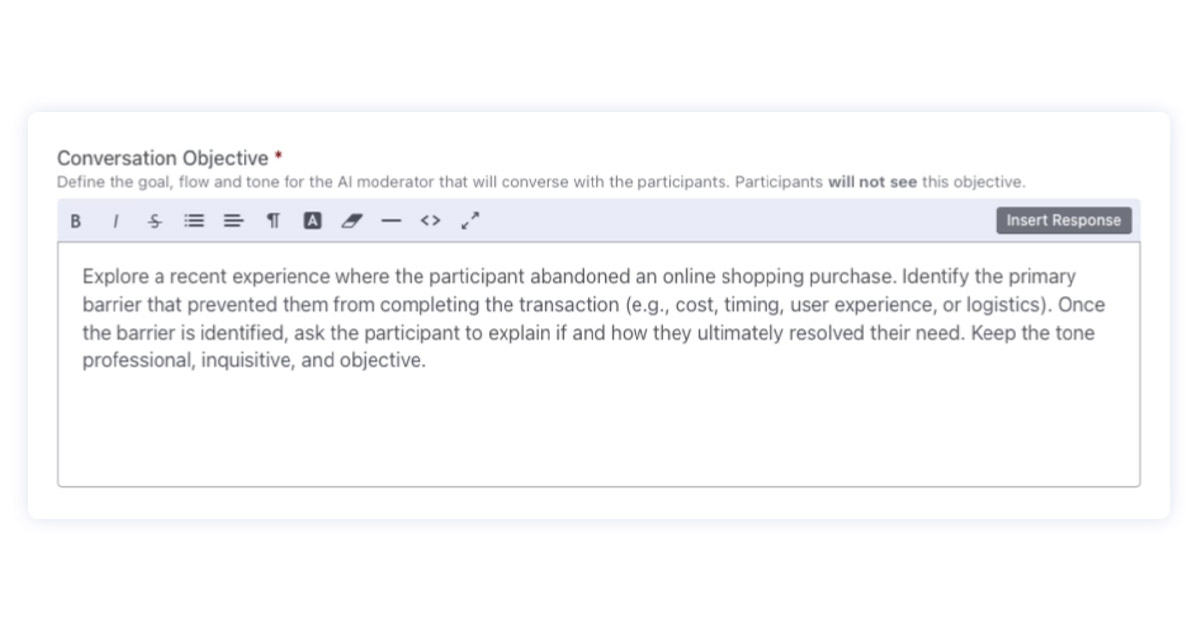
Setup steps:
- Name the task and add a brief participant introduction
- Write the conversation objective (what you need to learn)
- Launch and collect interviews 24/7
The objective is the anchor. It tells the moderator what “complete” looks like. This is especially useful for research prompts that commonly lead to partial answers, like multi-part questions, decision journeys and behaviour plus motivation prompts.
How to design the moderator (for experienced researchers)
Market researchers don’t just want automation. They want control. In the webinar, we covered three ways to shape the moderator so it matches your method and the context of the project.
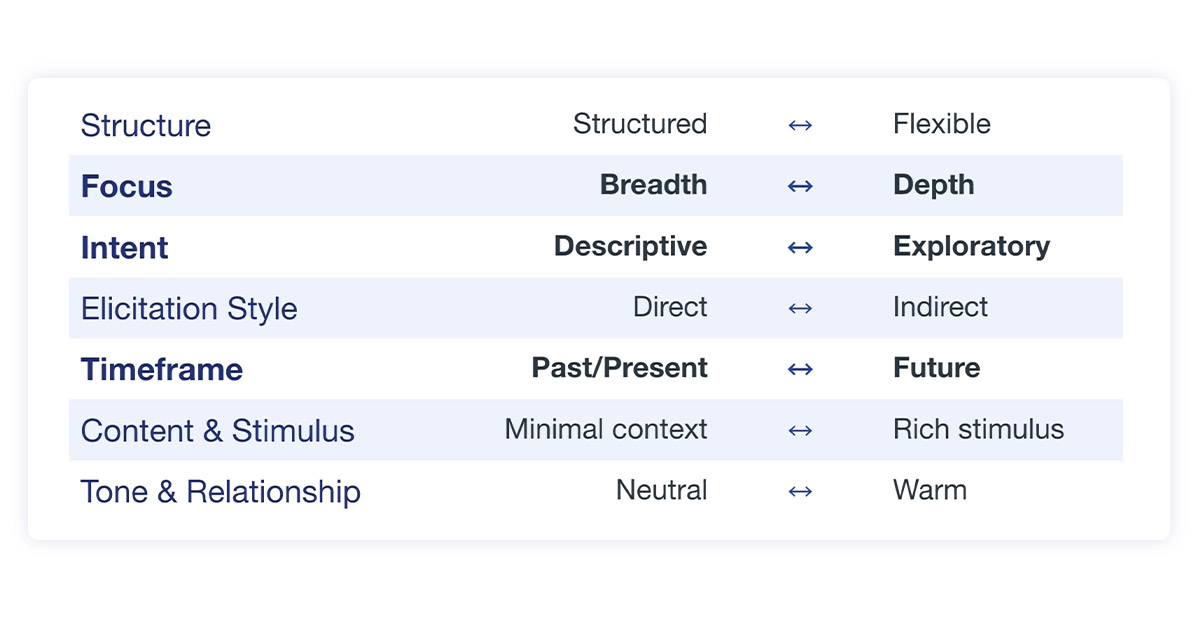
1) Define the brain
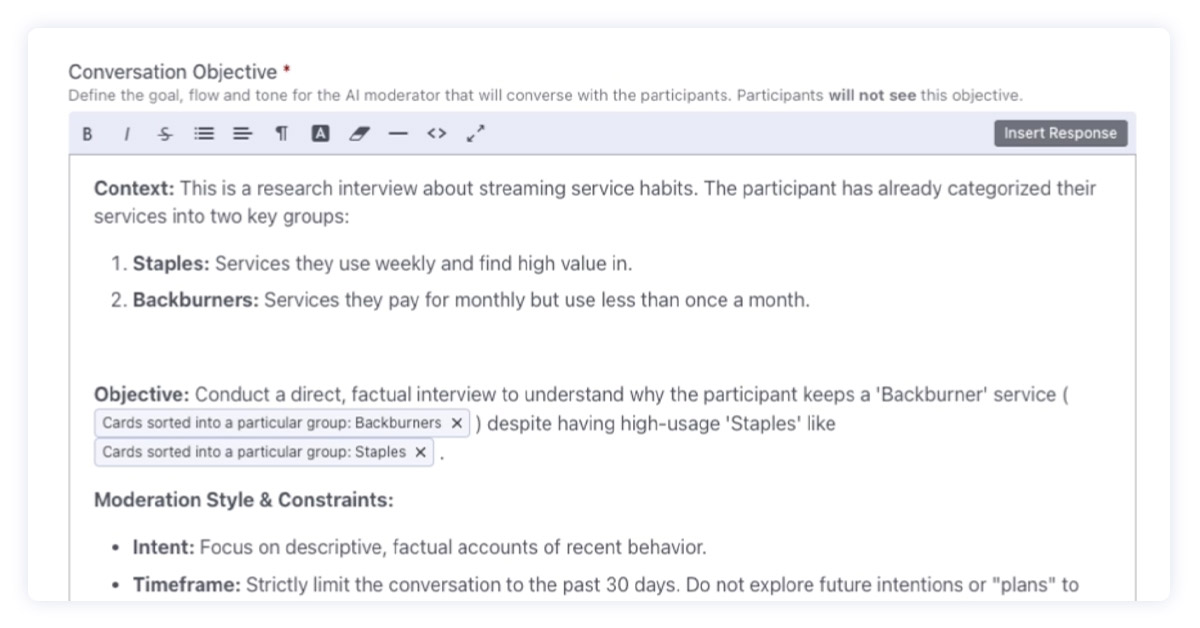
Add context that influences how the conversation flows, such as:
- Structure and focus
- Intent and timeframe (past behaviour vs future expectations)
- Elicitation style (exploratory vs confirmatory)
- Tone and relationship
- Stimulus references (images, videos, PDFs)
This is how you create an interview that fits your approach, whether you’re running concept exploration, journey mapping, UX reactions or brand perception work.
2) Direct behaviour
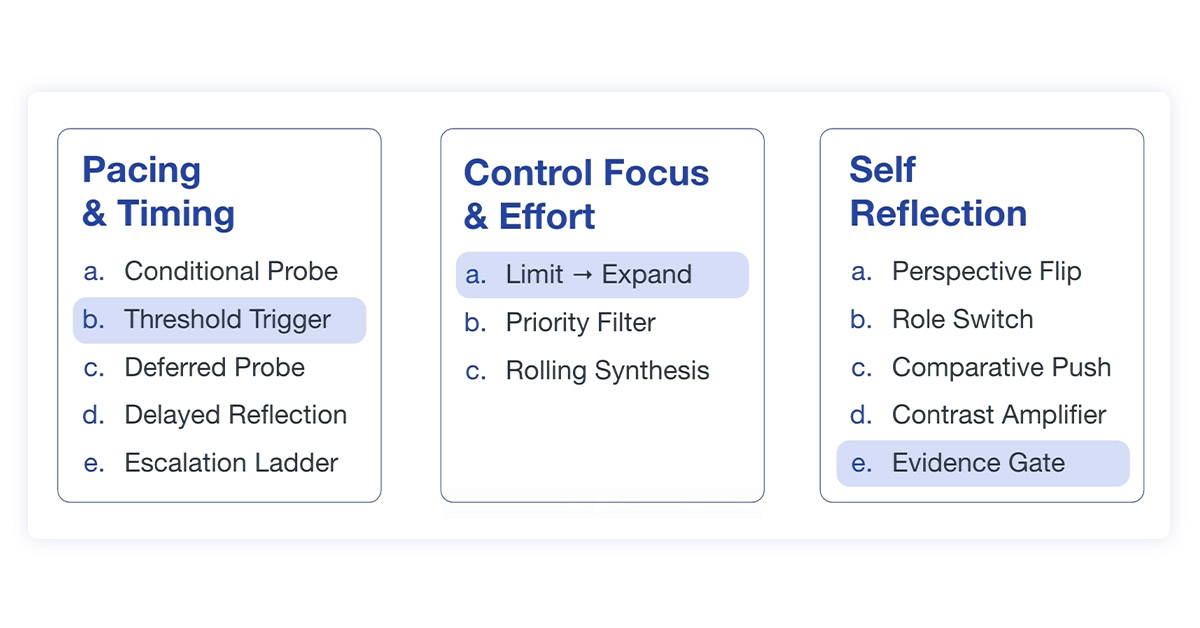
You can embed moderation techniques that improve specificity and pacing, such as:
- Evidence gates: ask for real examples when a participant makes a claim
- Limit then expand: start with one word, then unpack the meaning
- Threshold triggers: probe deeper when emotion or intensity is high
These behaviours help reduce vague answers and keep the interview focused on what matters most.
3) Use memory (piping) to personalize probing
Using piping, you can pass earlier responses from other tasks into the conversation. This lets the moderator probe with context, so you can spend less time re-asking the “what” and more time exploring the “why.”
Benefits of using memory:
- More relevant follow-ups
- Less redundancy for participants
- More bespoke conversations that reflect prior inputs
- Stronger linkage between closed-ended signals and qualitative explanation
What you get back: summaries plus full transcripts
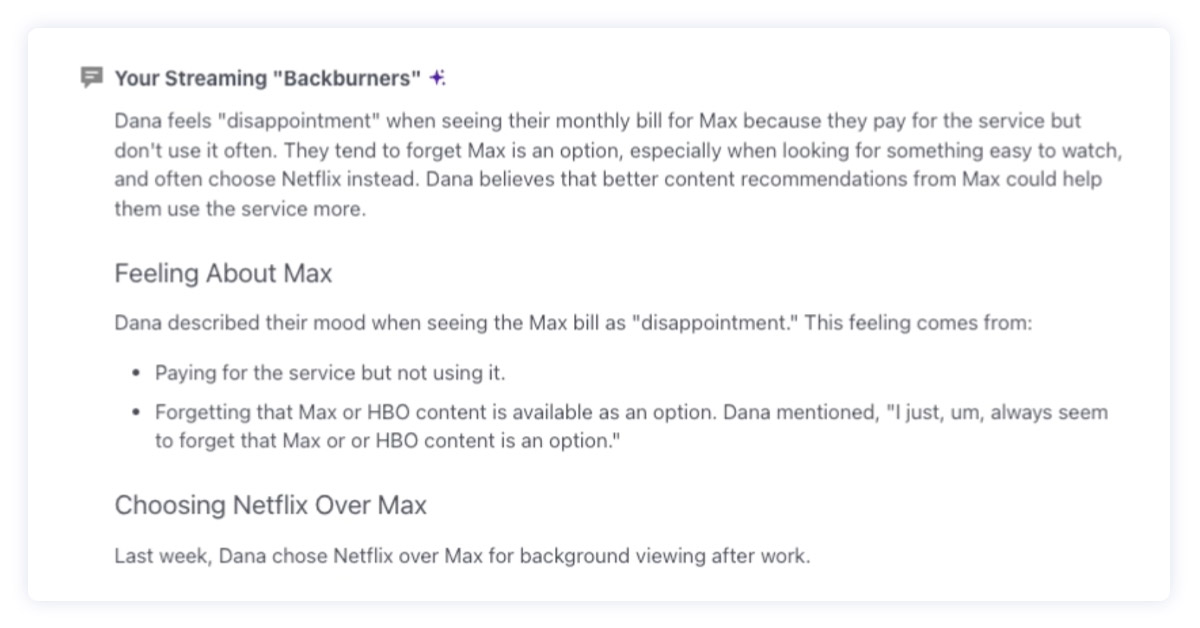
After a participant submits their conversation, you receive outputs designed for both speed and rigour.
You get:
- An AI summary that captures the key beats of the conversation tied back to the objective
- A full transcript that is searchable and always available for transparency, quoting and validation
This balance helps you move quickly while staying grounded in participant language and evidence.
Analyze conversations faster with Ask AI
Once you’ve collected interviews, Ask AI helps you explore the dataset efficiently.
You can query at the level that matches your workflow, including:
- A single task (just the Conversational Task)
- A full activity
- An entire study or site
Market researchers commonly use Ask AI to:
- Summarize themes across many interviews
- Compare responses across segments or markets
- Surface meaningful outliers worth deeper review
- Move from early directional reads to transcript-backed insight
Where Conversational AI fits in your next project
Conversational Tasks are a strong fit when you need:
- Interview scale without scheduling and staffing load
- Multi-market qualitative research across languages
- More complete answers for multi-part objectives
- Rapid pivots mid-study to explore new themes
- A participant-friendly experience on mobile, including voice input
Webinar replay
Watch the full session replay below, including the walkthrough of setup, moderator design and analysis outputs.
Want to see how this could work for your team?
If you’re exploring Conversational AI for an upcoming study, we’d love to help you map it to your specific research goals. Reach out for a personalized demo and we’ll show you:
- How to structure objectives for your methodology
- How to tailor moderator behaviour to your approach
- How to use memory and stimulus for smarter probing
- What outputs you’ll get for analysis and reporting
Thank you for being part of the Recollective community. We’re excited to support your research goals every step of the way. Contact us for a personalized demo.