
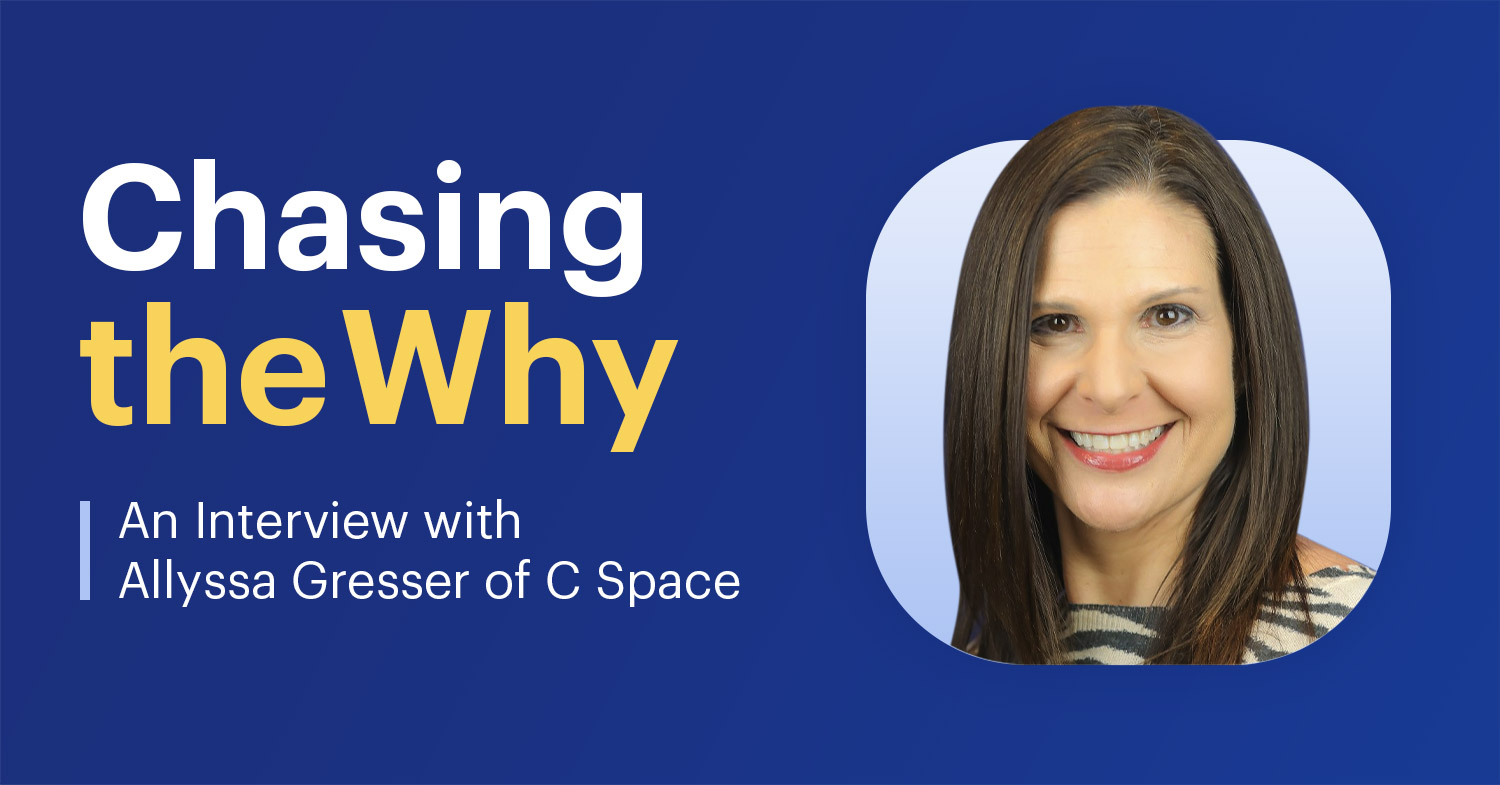
Welcome to The Research Happy Hour, where we chat with qualitative research professionals to learn about their career paths, passions and experiences.
For this installment of The Research Happy Hour, we sat down with Allyssa Gresser, a market research leader at C Space with more than two decades of experience across both the client and partner sides of the business. From coding how children reacted to Blue’s Clues at Nickelodeon to leading multi-method research programs today, Allyssa has built her career on one thing above all: curiosity. She is just as passionate about mentoring the next generation of researchers, and about using AI the right way, as a tool that sharpens the work rather than a shortcut that replaces the human behind it.
The 30-second version
Here are the main points Allyssa made during our chat:
- Stay curious. Anyone can read a chart. The job is asking why, then turning the numbers into a story.
- Relationships are the work. Make every client feel like your only client, and never leave an email sitting.
- Treat AI as a tool, not a replacement. Let it sharpen your analysis and storytelling. The human touch stays yours.
Falling Into Research
Like many researchers, Allyssa did not set out to work in insights. She started at the University of Massachusetts Amherst planning a career in psychology, then law, until a research job at Nickelodeon changed her direction entirely.
Q: Can you share your path and where you are today?
Allyssa: When I first went to school at the University of Massachusetts Amherst, I really wanted to go into psychology. I was involved in child psychology, and then I pivoted and decided I wanted to be a lawyer. What is funny is that when people say, “What do you want to be when you grow up?” I don’t think anyone chooses market research. Most people just fall into Market Research, and then develop their careers from there.
Allyssa: I took the LSATs, planning to go to law school. But in the meantime I got a job at Nickelodeon in New York City, in the research department. From there I really discovered my love and passion for research, my curiosity for research. One morning I just said, “I don’t really want to be a lawyer anymore. I’m loving understanding people’s emotions and reactions, both quantitatively and qualitatively.”
“I don’t think anyone chooses market research. Most people just fall into it, and then discover they love it.”
Two Sides of the Table
Allyssa has spent time on both the client side, at brands like Nickelodeon and Scholastic, and the partner side, where she works today. She is clear that seeing both perspectives made her a stronger partner.
Q: You have moved from client-side brands over to the partner side. Can you speak to that experience?
Allyssa: On the client side, I learned what the client wants, what to look for, what to ask for when you are working with partners. So on the partner side, now I can anticipate what my clients are looking for, because I was there. I have been in many internal meetings where they say, “I don’t know, what do you think?” And I say, “Well, the client is going to want to see X, Y and Z. I can tell you that for sure.” I don’t think you have to have experience on both sides of the business, but it definitely helped shape who I am in the research world.
That client-side empathy shapes how she scopes work. Her varied experience has also given her the understanding that sometimes clients come in very set in what they want and need, and sometimes they don’t. Allyssa has the experience and expertise to be able to talk through different approaches and methods and offer up her own suggestions when the client is open to it.
“Don’t tell me what approach you want to use. Tell me what your challenge is, tell me what your objective is. My goal is to turn that into actionable insights.”
Q: Would you recommend young researchers try both sides?
Allyssa: It is not necessary, BUT if you can, 100%. It gives you the full picture. I do think it is easier to move from the client side to the supplier side than the other way around. So if you wanted to try both, I would say try to start on the client side.
Relationships That Keep Clients Coming Back
We asked Allyssa about her biggest strength and she did not hesitate. It is the relationships.
Q: What is it like building those long-term client relationships?
Allyssa: I am lucky enough to work in an area where I have ongoing clients, so it is not a lot of one-and-done projects. You develop rapport where possible. Your goal is always to make them feel like they are your only client.
She has one rule she has passed on to everyone she has mentored.
Allyssa: Never let an email go unanswered for more than a few hours. Even if it is just, “Hey, I’m super busy today, I’ll get back to you tomorrow.” Don’t let them sit there wondering, “Did they get my email? Why aren’t they responding?” That is why clients keep coming back. They know I’m responsive, and I get them what they need.
“Your goal is always to make the client feel like they are your only client.”
That network mindset extends well beyond active projects. Allyssa still turns to her early female mentors from Nickelodeon. Today, she keeps those connections active with regular touchpoints on LinkedIn.
Allyssa: LinkedIn is a huge tool. I’m on it every single day, keeping in touch with people and following brands and trends. I use it to keep up with what is going on in the industry so I don’t have to go mine it all over the place. I would tell anyone: connect with anyone and everyone.
Look Beyond the Numbers
When we asked for her best piece of advice, it doubled as her philosophy of research.
Q: What is one piece of advice you would give someone beginning their career in market research?
Allyssa: Don’t settle for the numbers. Stay curious all the time. You have to be a curious person to get excited and stay in market research. Look to uncover the motivations and needs of your customers. Always ask questions.
Early in her career, a manager pushed her past a report that was merely “fine”, and taught her she needs to be able to tell a story.
Allyssa: She got me to figure out how to tell a story. How do we translate numbers into English? The truth is, anyone can read a number. Anyone can say, “That chart says 55% of people say this.” Well, okay, who cares? What does that mean? A client may say, “We want to know which tagline is best.” I want to know why they like that tagline, and why they don’t like the other one.
“Anyone can read a chart. The real point is the storytelling: making the research so impactful the client can take it to the next level.”
That instinct recently reshaped an entire engagement. A client came in wanting a single survey. Allyssa’s team “brought the brief” back with something more ambitious.
Allyssa: We felt the approach the client wanted was not going to get them what they needed. So we laid out an entire research proposal. At first the client said, “I really want this.” And I said, “Just give this a chance.” We turned one survey into five different research activities which spanned over almost three months, then built one big presentation with video clips, quantitative data and qualitative journey mapping. The client was so excited and almost surprised at where we started and where we ended. That goes back to being curious, asking the questions I want answered, not just what the client told me.
Leading Without the High Horse
Shaped by strong mentors of her own, Allyssa now takes mentorship seriously.
Q: What does leadership look like in a research context, and how do you support junior researchers?
Allyssa: Leadership in market research is not being on my high horse. I’m willing to get deep into the numbers, I’m willing to write a survey. Especially in this virtual world, leadership is being someone people can come talk to. I have an open-door policy. My calendar is always up to date, and I have weekly and biweekly meetings with everyone from analysts to directors. Sometimes it is about the work, sometimes it is career advice, sometimes someone just needs to vent.
Being approachable does not mean avoiding the hard parts.
Allyssa: If I’m reviewing a report and it needs work, I’m not going to just go in and make the changes myself, even though sometimes I want to. Leadership is giving that feedback: sitting down and talking through my comments so you can apply it across the whole report yourself.
“Leadership in research isn’t being on your high horse. It’s being someone your team can actually come and talk to.”
AI as a Tool, Not a Replacement
Allyssa earned an AI Champion certification through a company-wide program, and she has become a genuine advocate with clear eyes about the limits.
Q: Is AI something you see being adopted across the industry?
Allyssa: You must, must, must embrace AI. A lot of people are scared of it. They think it is going to steal jobs. But AI is happening whether you like it or not. It is how you use the tools that matters. The AI program at my company was one of the best things I have gained here. It helped me understand where AI started, where it is going, and gave us training on tools we now use every day.
Her framing is refreshingly practical.
Allyssa: AI shouldn’t replace what you are doing. It is not going to steal your job. It should be a tool, not a replacement, and help you do your job better. You shouldn’t spend three hours writing a survey. But you should spend three hours being deep in the analysis, really digging in and learning how to tell the story.
AI is great, and it is a tool, but it is not something that should take over what you are doing. AI doesn’t uncover emotions. AI doesn’t discern behaviors. That is still the human touch we need.
“AI is a tool, not a replacement. It doesn’t uncover emotions or discern behaviors. That is still the human touch.”
For Allyssa, the best use of AI is as a starting point.
Allyssa: I use it for inspiration, not for that final deliverable. If I use it to rewrite headlines or summarize a transcript, I still read it and make sure it sounds like me. It helps you focus on the real story and the real human behaviors, and then AI becomes the assist.
Final Reflections
Allyssa’s story is a reminder that the best researchers often discover the field rather than plan for it—stumbling into the profession and staying for the love of discovery. Across more than two decades and both sides of the table, her throughline never changes: look past the number to the human behind it, invest in the relationship and let new tools sharpen the craft.
Thank you, Allyssa, for sharing your time and your insights with us. Stay tuned for more conversations in The Research Happy Hour series.
Keep Exploring
Allyssa’s themes run right through our own work. If her thoughts on AI and communities resonated, these are worth a read:
- How to Get Richer Qualitative Responses with AI-Moderated Interviews
- Market Research Online Communities (MROCs): A Complete Guide
- Insight Community Best Practices: A Complete Guide
Curious how Recollective supports multi-method qualitative research and long-term communities? Book a demo.
About C Space
C Space is the leading market research online community, customer strategy and innovation agency, putting relationships at the heart of business to drive growth. Since joining Escalent Group in 2023, C Space is now a team of 1,600 researchers, data scientists, moderators, creatives, developers and UX professionals working across 150 countries in more than 50 languages.
Love chatting qual just as much as we do?
Email us at marketing@recollective.com for a chance to be featured on The Research Happy Hour series.




.svg)