Open-ended questions are supposed to produce depth. Most of the time, they produce the opposite. Ask a participant to share their experience in a text box and you're handing them a blank canvas: no starting point, no scaffolding, no one on the other side. What you get back reflects the format, not the participant.
In her session at Insight Platforms' Demo Days, Amy Mullen, Strategic Customer Success Manager at Recollective, walked through why this happens and how Recollective's Conversation Task changes what researchers get back. The session covered four research scenarios — exploratory work, concept and message testing, innovation and co-creation, and shop-alongs — with live platform demos for each.
If you missed the live session, the recording is available on demand.
What is the Conversation Task?
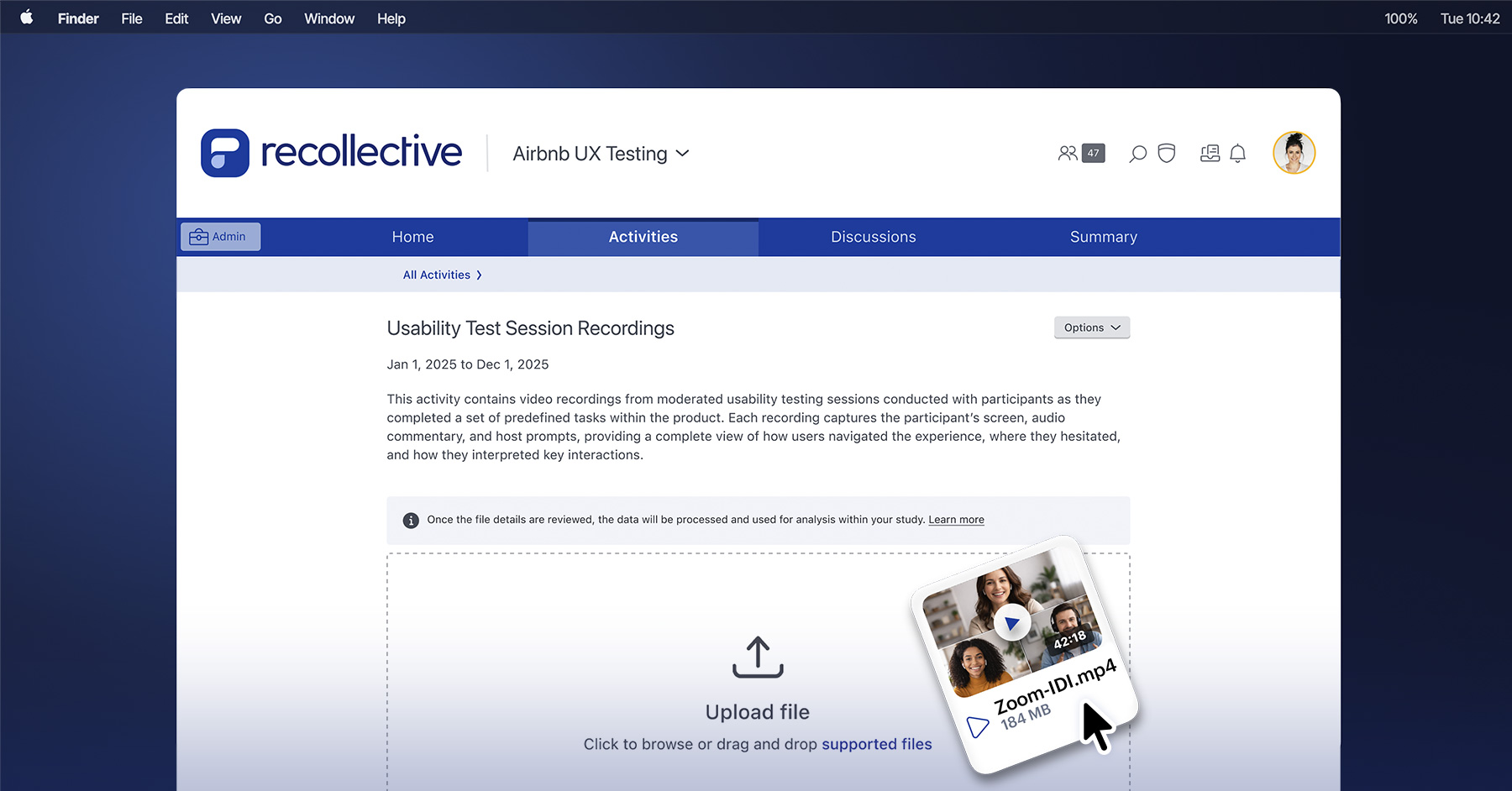
The Conversation Task is an AI-moderated interview built directly into the Recollective platform. It replaces static open-ended prompts with a dynamic, one-to-one chat experience that adapts in real time to what each participant says.
Researchers write a conversation objective — as broad or as structured as the research requires — and the AI moderator uses it to guide each participant through the discussion, probing follow-ups based on what they actually say rather than following a fixed script. Because it runs asynchronously, participants engage on their own time, when they're in the right headspace, rather than at a scheduled time that may not suit them.
At the close of every interview, researchers receive an AI-generated summary at the individual level, alongside fully exportable transcripts. Task-level summaries across all interviews are also available, helping teams surface themes quickly and move into analysis faster.
Exploratory Research
Exploratory work is where the blank canvas problem hits hardest. Broad, abstract prompts — "Tell us about your morning" or "How do you think about this category?" — invite exactly the flat, surface-level answers researchers are trying to avoid. Without a skilled moderator in the room, an open prompt can't carry that load on its own, so researchers compensate: more structure, more scaffolding, more questions, often narrowing the focus before the exploration has really begun.
The Conversation Task changes the dynamic from the first exchange. The AI moderator opens the way a skilled interviewer would — warm, curious and genuinely responsive to what the participant says. When the first answer is short, it asks the follow-up a researcher would. It listens for the threads worth pulling on, simultaneously, across every participant, without the researcher needing to be there.
The objective for exploratory work can stay deliberately broad. Amy's example from the session: "Understand how participants think about snacking in their daily lives. Follow whatever threads feel meaningful. Let the participant lead." That's all the instruction the AI moderator needs. The outcome is richer baseline data, the real texture of how people think about a category, with participants already warmed up to the format if the Conversation Task appears again later in the study.
Concept and Message Testing
Multi-concept studies create a specific kind of blank canvas problem. By the time participants have worked through two or three concepts — reacting in text boxes, answering closed questions, repeating the sequence — they're tired, and the concepts are blending together. That's the exact moment researchers ask the hardest question: "Why did you choose this one?" One more empty text box, right when depth matters most.
The Conversation Task handles both concepts in a single AI-moderated interview, holding them in view simultaneously and probing the comparison while the experience is still fresh. The key feature in this context is piping: the AI moderator references each participant's specific earlier responses directly within the conversation. If a participant chose one concept in a prior poll, the interview is anchored to that choice throughout.
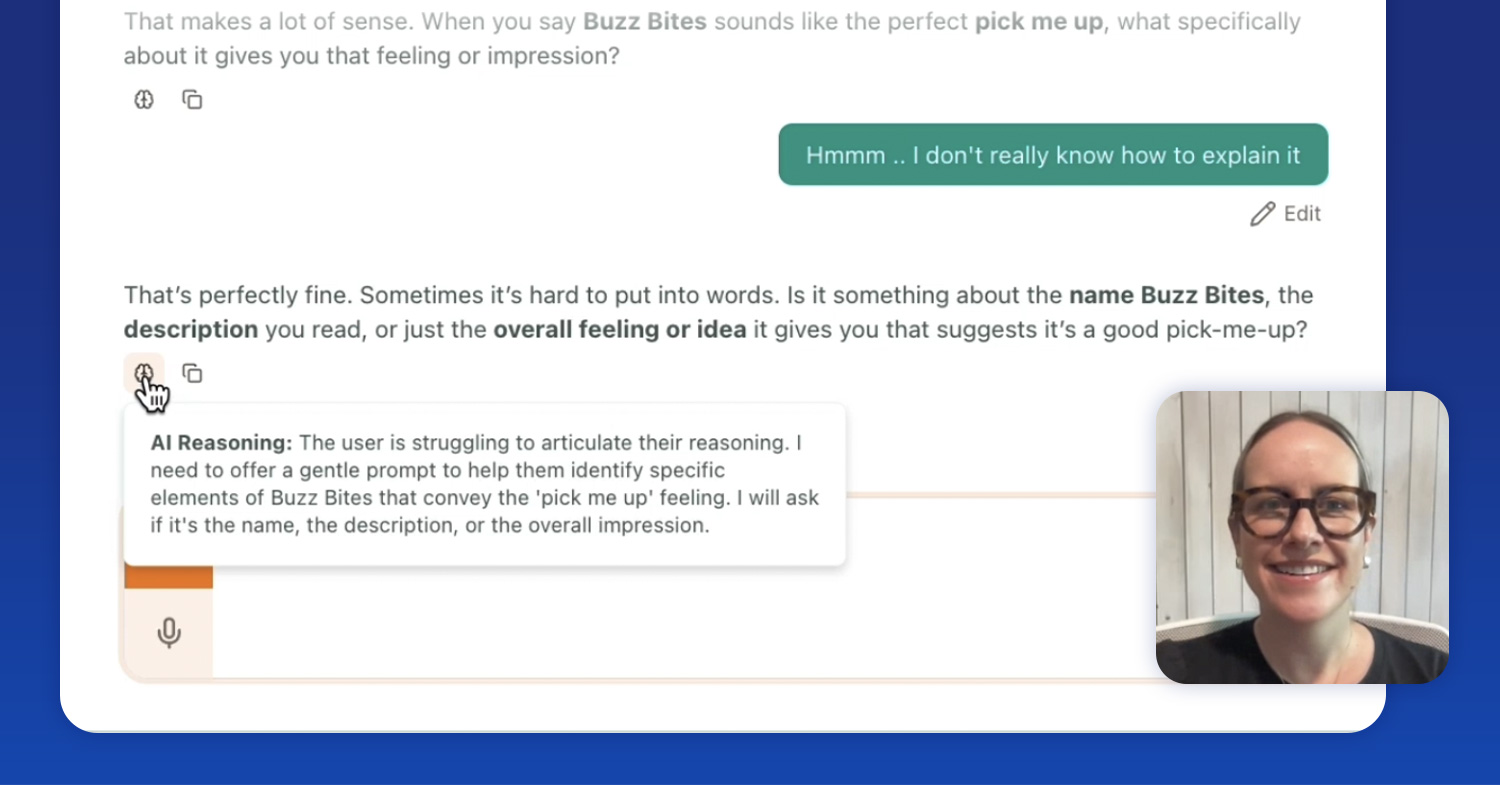
The platform's brain icon adds a layer of transparency that matters for research integrity. Hovering over it reveals the reasoning behind each probe, confirming the AI stayed within the guardrails set in the objective. Researchers can also build hard constraints into the objective — how the moderator should handle a participant who's struggling to articulate an answer, a cap on the total number of probes — and the brain icon is proof those constraints held. The result isn't just knowing which concept won. It's understanding why it won and what it beat.
Innovation and Co-Creation
Asking participants to generate something new is one of the harder things a study can require. Creative thinking is fragile — it needs warm-up and the freedom to offer a half-formed idea and build on it. A text box does the opposite: every response feels permanent, so participants self-edit before they've finished thinking, setting aside the more interesting idea and submitting the safe, polished one instead.
The Conversation Task can take a first tentative idea and develop it, pushing participants past that initial obvious answer to the second and third idea, where the originality tends to live. Talk Mode is particularly well-suited here: participants speak their response rather than type it, the system transcribes instantly, and the AI moderator replies in kind, keeping the creative momentum going. The difference in what comes back when someone can speak freely, rather than compose, is significant.
Auto-translation makes global innovation sessions genuinely practical. Researchers program the conversation objective once in their native language, and the platform handles translation automatically into any study language. The same conversation runs in parallel across every market, without any additional setup.
Shop-Alongs and In-Context Research
Shop-along research is defined by timing. The insights researchers want — the micro-moments of in-store decision-making — are vivid immediately after the experience and fade quickly. Standard practice keeps in-store tasks minimal to avoid overloading participants, pushing the deeper "why" questions to a post-shop reflection completed at home. What comes back from that reflection is often thinner than hoped.
The alternative Amy walked through: the moment a participant crosses the checkout, they open the Conversation Task on their phone for a focused three-minute debrief, still in the parking lot, while the memory is intact. The Response Awareness feature takes this further. When toggled on, the AI moderator has full access to everything the participant has already said earlier in the same activity, including the automatic speech-to-text transcription of their in-store videos. It doesn't start from a blank slate. It probes directly on what the participant said in the moment, pulling on the specific threads they raised while they were actually in the store.
This is possible because the Conversation Task is built into Recollective rather than operating as a separate tool. The data stays connected, the analysis stays unified and the participant experience stays seamless.
When to Reach for It
Amy's framing at the close of the session: reach for the Conversation Task when the why matters more than the what. More specifically, when you need depth that live interviews at scale can't deliver, when the value is in the probe and the follow-up, when consistency across many participants or markets matters, or when timelines won't bend.
Every feature covered in the session — piping, response awareness, the brain icon, Talk Mode, auto-translation and AI-generated summaries — works across all four scenarios. They're not tied to specific use cases. They're tools to mix and match based on what the research needs.
One point Amy made explicit at the close: the Conversation Task is a complement, not a replacement. It doesn't replace 60-minute live IDIs, open text for quick capture, surveys for scale and structure, or live groups for group dynamics. It slots in alongside them, a new question type feeding into the same analysis environment, inside one connected study. As Amy put it: "It was never the participant. It was always the format."
Watch the Full Session
The live Q&A covered additional ground worth catching in the recording, including how to write effective conversation objectives, how to combine the Conversation Task with other Recollective activity types and how to build guardrails that keep the AI moderator on track without over-constraining it.
Watch the full recording with Q&A on Insight Platforms here.