The goal is not just to collect responses. It is to generate deeper, more continuous insight.
That is the appeal of an online research community. Instead of talking to participants once and moving on, researchers create a private digital environment where they can engage the right people over time, ask follow-up questions, observe changes and build a richer picture of customer attitudes, behaviors and needs.
An online research community, often called an MROC, is a private online space where selected participants take part in research activities over a defined period of time. Those activities might include discussions, journals, polls, multimedia uploads, diary exercises or live sessions. The goal is not just to collect responses. It is to generate deeper, more continuous insight.
If you have heard the term Market Research Online Community, that is what MROC stands for.
Key takeaways
- An online research community, or MROC, is a private group of participants engaged in research over time
- MROCs help teams move beyond one-off studies and understand the context behind customer behavior
- They are especially useful for exploration, diary studies, journeys, concept feedback and long-term insight programs
- MROCs sit between traditional surveys and live group discussions by combining flexibility, depth and continuity
- The best online research community platforms support strong moderation, flexible activity design, participant management and enterprise-grade governance
What is an MROC (online research community)?
At its simplest, an online research community is an environment built for ongoing learning.
Researchers invite a specific set of participants into a private digital space and guide them through a series of activities. Those activities may happen over a few days, a few weeks or much longer. The format can be highly structured or more open-ended depending on the research objective.
This is what makes an MROC different from a one-time survey or interview. You are not just collecting a single answer at a single moment. You are creating the conditions to learn over time.
That matters because many important research questions are not answered in one sitting. How do people make purchase decisions? Where does friction show up in a customer journey? How do attitudes change after product use? What language do customers use when describing an unmet need? Those are often better answered through repeated engagement rather than a single touchpoint.
You may also hear people use terms like online insight community software or research community platform. In practice, these often point to the same basic idea: a digital space for deeper, ongoing customer understanding.
How does an MROC work?
Most online research communities follow the same broad pattern.
First, researchers recruit the right participants. That might mean current customers, prospects, employees, patients, users in a target segment or any audience relevant to the research question.
Next, participants are onboarded into a private community. Researchers may screen them, segment them and guide them through an introduction so the experience feels clear and intentional from the start.
Then the research begins. Depending on the study design, participants might:
- answer discussion prompts
- complete journals or diary tasks
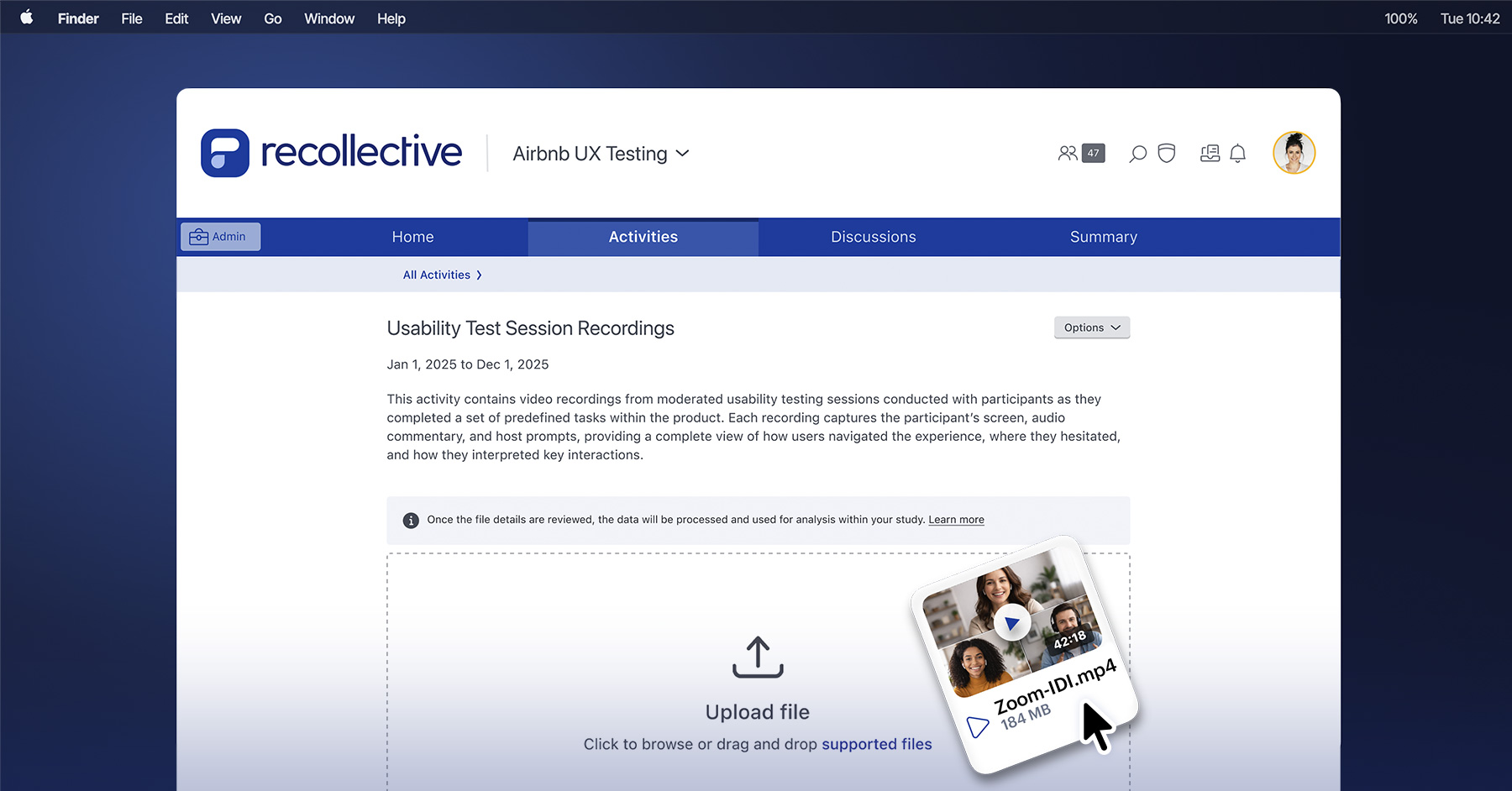
- upload photos, videos or screenshots
- respond to polls or short exercises
- join live interviews or group sessions
- react to concepts, messages or prototypes
- comment on other responses where appropriate
Researchers moderate along the way. They ask follow-up questions, probe for clarity, spot emerging themes and adjust the plan based on what they are learning.
Finally, the team analyzes the responses, identifies patterns and turns findings into clear recommendations.
The key difference is continuity. Because the community persists over time, you can revisit topics, test new ideas quickly and compare what people say at different points in their experience.
Why use an online research community?
The strongest reason to use an MROC is simple: it gives you more context.
A survey may tell you what percentage of people prefer one concept over another. A focus group may reveal a lively reaction in the moment. An online research community can help you understand the thinking behind those reactions and how they evolve over time.
That creates several advantages.
You get deeper insight.
Participants have more space to reflect, respond in context and share richer detail than they often would in a single-session format.
You can follow up quickly.
When a surprising theme appears, you do not have to start from scratch. You already have a group you can return to with new questions.
You can study change over time.
This is especially useful for onboarding journeys, habit formation, brand perception, product usage and other topics that unfold across days or weeks.
You build a reusable research asset.
For in-house teams, that can mean less scrambling to launch every study from zero. For agencies, it can mean more efficient collaboration and a stronger foundation for ongoing client work.
You support multiple stakeholders.
A well-run research community can help product, CX, marketing and strategy teams get answers from the same participant base without losing methodological control.
For teams trying to scale qualitative research without reducing it to shallow feedback, MROCs offer a practical middle ground. They create repeat access to people while preserving depth.
Common MROC use cases
An online research community is not one method. It is a flexible environment that can support many methods.
1. Early-stage exploration
When you are trying to understand unmet needs, category perceptions or emerging behaviors, communities create space for discovery. Participants can share stories, language and experiences that might never surface in a more closed-ended format.
2. Customer journey research
Journeys rarely happen in a single moment. MROCs let researchers track decision-making, usage, frustrations and emotional highs and lows as they happen.
3. Product or concept feedback
Communities are useful for testing ideas iteratively. You can show a concept, gather reactions, refine it and return with a second version.
4. Diary studies
If you need in-the-moment capture, an online research community is a natural fit. Participants can log behaviors, upload media and reflect on experiences as they occur.
5. Co-creation and ideation
Because communities allow dialogue over time, they work well for collaborative exercises where participants react to prompts, build on ideas and help shape future directions.
6. Long-term insight communities
Some teams maintain always-on communities to stay close to customers on an ongoing basis. This can create a steady stream of input rather than a cycle of isolated projects.
MROC vs survey vs focus group: what’s the difference?
These methods are not interchangeable. Each has strengths.
A survey is ideal when you need scale, structure and measurable answers. A focus group is useful when you want live reactions and participant interplay. An MROC is best when you need continuity, richer context and the ability to return to the same audience over time.
It is also worth distinguishing an MROC from a panel. A panel is usually a source of participants. An online research community is the environment where the research happens.
In practice, many research teams use these methods together. A survey may identify patterns. A focus group may pressure-test ideas. An MROC may uncover the why behind both.
What should you look for in an online research community platform?
Not every platform is built for the same type of work. If you are evaluating options for online research community software, focus less on broad claims and more on practical fit.
Look for:
Flexible activity types
You want more than a basic discussion board. Strong platforms support a mix of asynchronous tasks, journals, polls, multimedia responses and live sessions.
Participant management
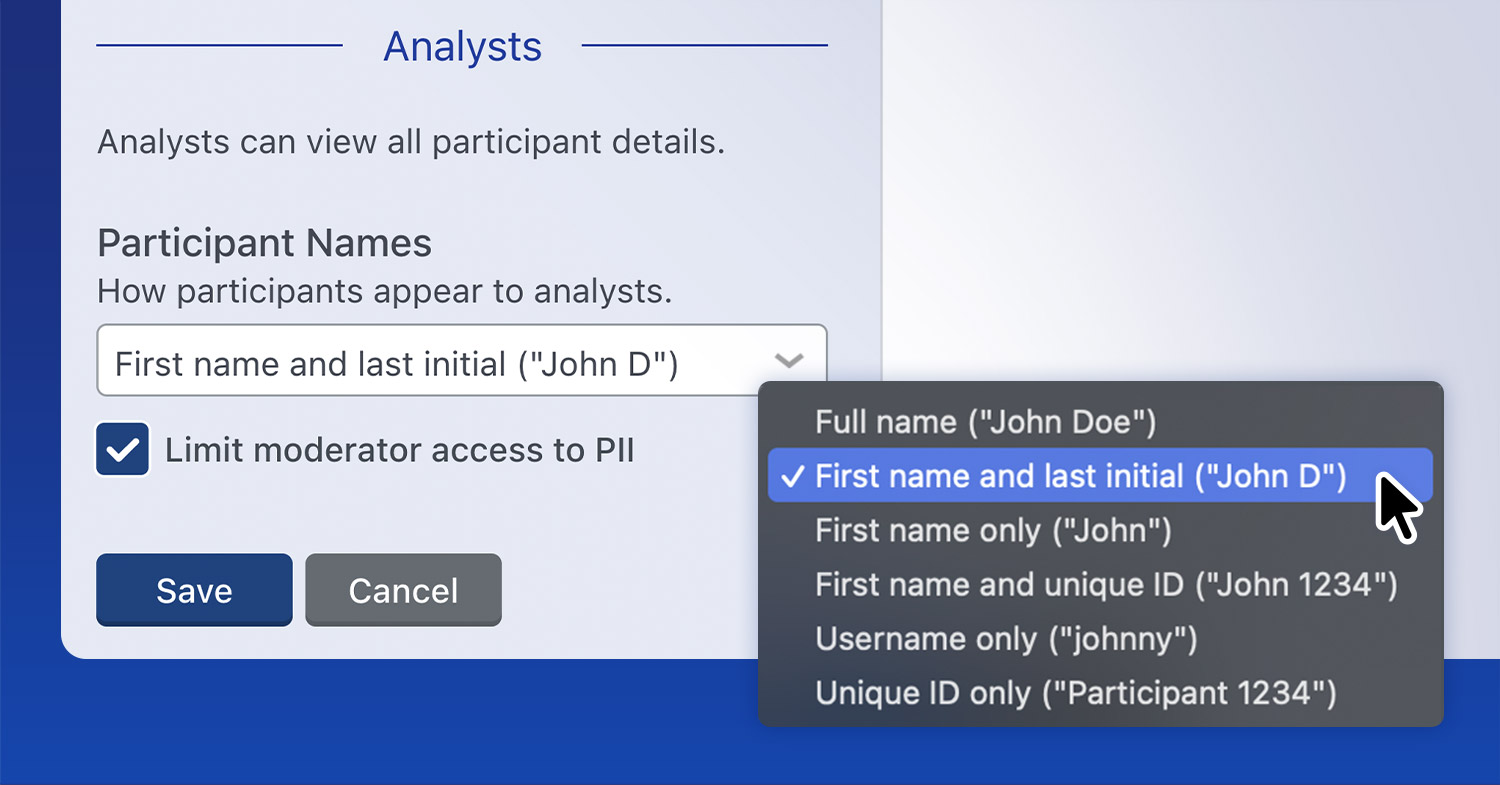
Screening, segmentation, onboarding and permissions all matter. The quality of your research depends partly on how well you can organize the right people.
Strong moderation tools
Researchers need the ability to probe, comment, guide participation and keep the experience engaging without losing control.
Analysis support
Communities generate a lot of unstructured data. Look for tools that help teams review, organize and synthesize responses efficiently while keeping the researcher in charge of interpretation.
Support for multilingual or multi-market work
For global teams, language support can become a deciding factor quickly.
Security and governance
This matters early, not late, especially in enterprise settings. IT, procurement and legal teams will ask about access controls, privacy, authentication, hosting and data handling. It helps to be ready with clear answers.
Fit for your operating model
Some teams need a short-term project environment. Others want an always-on connected community that can support multiple studies over time. The right platform depends on how you plan to work.
When is an MROC not the right fit?
As useful as online research communities are, they are not the answer to every question.
An MROC may not be the best choice when:
- you only need a quick one-time pulse
- your main goal is statistically representative measurement
- your question can be answered cleanly through a single interview or short survey
- you do not have the time or resources to moderate and synthesize rich qualitative input
This is important. Research communities are valuable because they create depth. If your need is narrow, fast and highly structured, another method may be more efficient.
How to launch an online research community successfully
A good MROC starts with a clear research plan, not with the technology.
Here are six practical steps:
Final thoughts
So, what is an online research community?
It is a way to move from isolated feedback to ongoing understanding.
An MROC gives researchers a private space to engage the right participants over time, ask better follow-up questions and uncover the context behind behavior, attitudes and decisions. For teams that need more than a snapshot, that can be a major advantage.
The best online research communities do not replace other methods. They complement them. Used well, they help research teams build depth, speed up learning and create a more durable connection to the people they serve.
Explore how the Recollective qualitative research platform supports online research communities and connected research programs built for deeper qualitative insight. Get a demo today.