When you run a Conversation Task in Recollective, you already get AI-generated summaries built around your research objective — rich, fast and ready for review. Conversation Summary Guidelines take that foundation a step further. As studies scale, the ability to define exactly how summaries are structured becomes a real advantage. Instead of reviewing outputs that vary in format from one participant to the next, you set a consistent framework up front — so every summary follows the same structure, making it faster to compare findings, easier to spot themes and more natural to move from synthesis to reporting.
What Are Conversation Summary Guidelines?
Conversation Summary Guidelines add a new layer of control and consistency to AI-moderated Conversation Tasks. They let admins define exactly how participant summaries should be structured, so every summary follows the same objective-driven framework—across every respondent in the task.
Instead of hoping the AI organizes information in a way that’s useful to you, you now set the rules up front.
How It Works
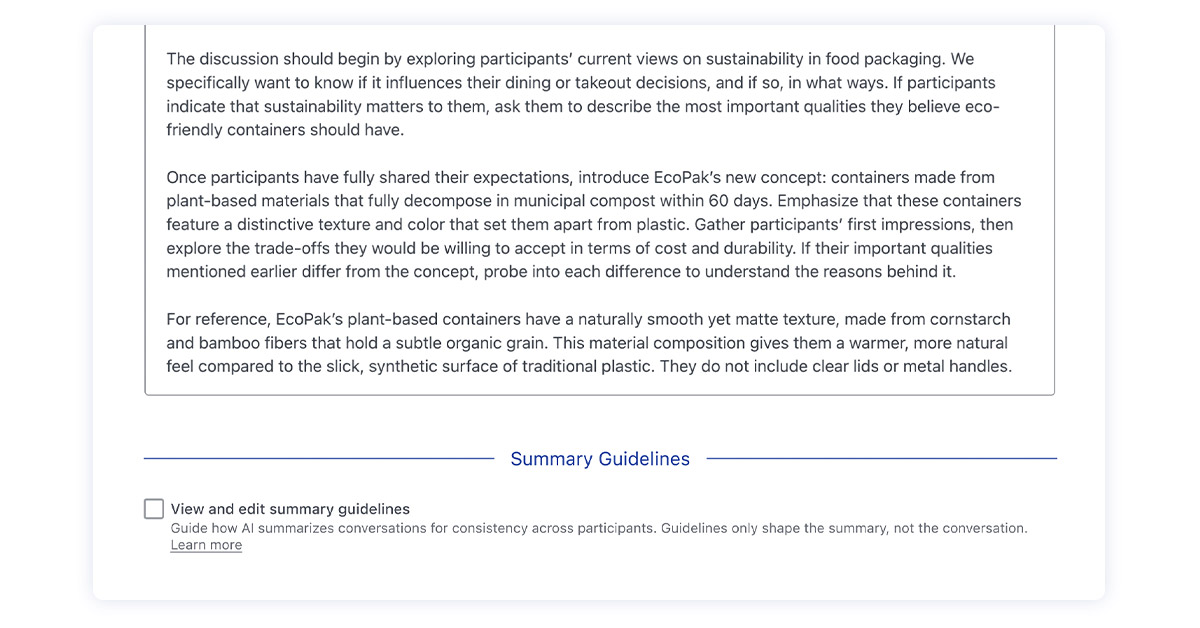
1. Your Objective Becomes the Structure
During setup, Recollective uses your Conversation Objective to automatically generate Summary Guidelines—a clear set of headers and prompts that guide how the AI summarizes each completed conversation. The result? Summaries that stay focused on what you actually need to learn, not whatever the AI decides is interesting.
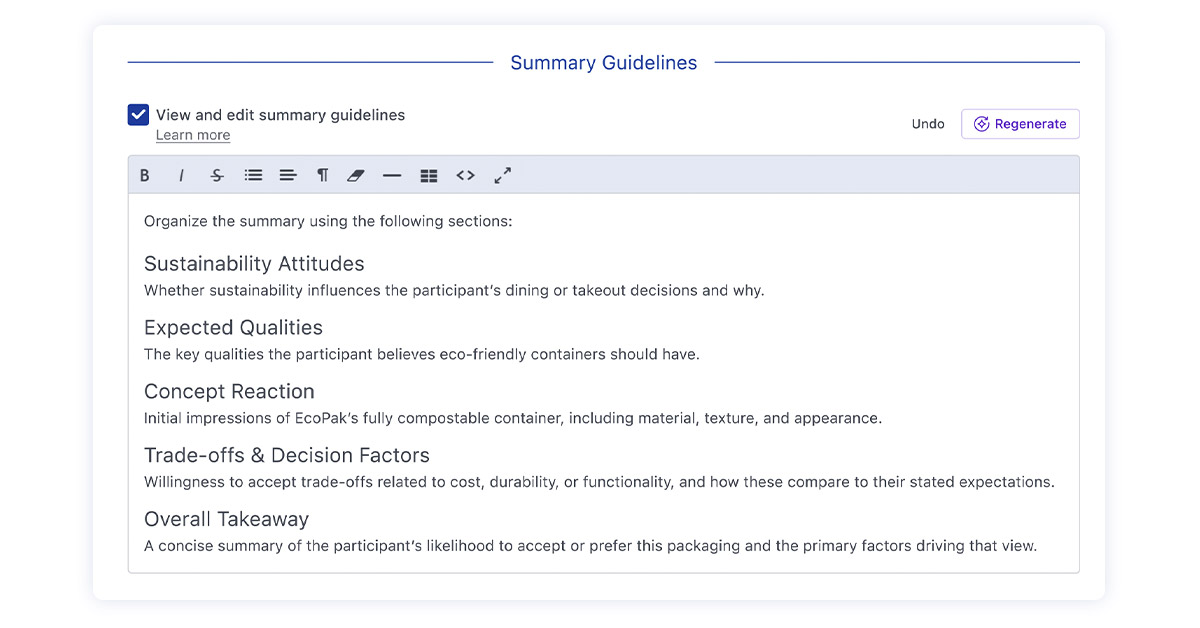
2. Edit the Framework to Match Your Workflow
The auto-generated guidelines are a starting point, not a locked template. You can update the headers, adjust the prompts and reshape the framework to fit your reporting style, stakeholder needs or analysis workflow. This means less cleanup after the fact and more time focused on the findings themselves.

3. Preview and Refine Instantly
Before you launch, you can preview the Summary Guidelines alongside a generated summary in a single modal view. Made a tweak? Refresh the summary right away to confirm it delivers what you need. No guessing, no waiting for live data to find out the structure doesn’t quite work.
4. Consistent Summaries Across Every Participant
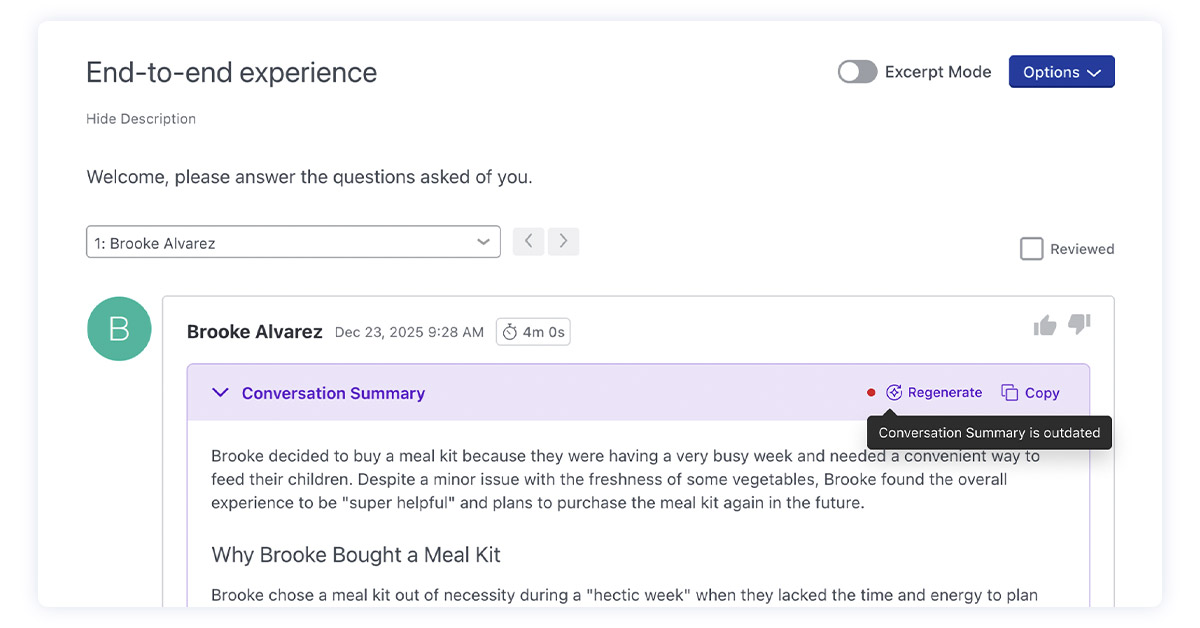
Once the task is live, the same guidelines are applied to all participant summaries. The output is uniform, comparable and aligned to your research goals. This makes cross-participant analysis dramatically faster and more reliable.
Why This Matters for Your Research
Qualitative research platforms have made it easier than ever to collect rich conversational data at scale. But analysis at scale has remained a bottleneck—especially when AI-generated summaries lack a consistent structure.
With Conversation Summary Guidelines, you get:
- Faster comparison: When every summary follows the same structure, scanning across participants becomes second nature.
- Clearer pattern recognition: Structured consistency makes it easier to spot recurring themes, outliers, and unexpected insights.
- Less rework: Summaries arrive in a format your team can use immediately, reducing the time spent reformatting before sharing or reporting.
- Greater confidence in outputs: Objective-driven, standardized summaries give you—and your stakeholders—more trust in the analysis.
Ready to Try It?
Conversation Summary Guidelines will begin rolling out to all Recollective customers soon. If you’re already using Conversation Tasks, head into your next task setup and look for the Summary Guidelines option during configuration.
New to Recollective, or want to see how this fits into your research workflow? Reach out to our Sales team for a personalized walkthrough. We’d love to show you how Summary Guidelines—along with the rest of the Recollective platform—can help you move from data to decisions, faster.